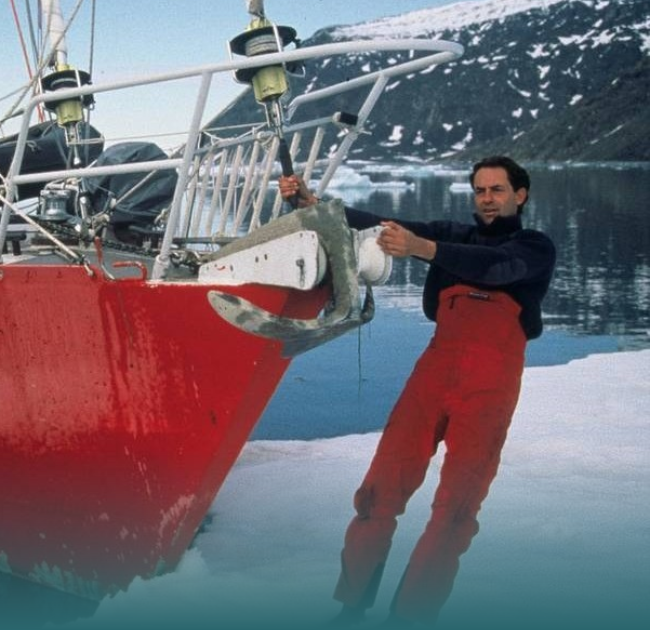
On June 10, 1984, Amyr Klink set out alone from Namibia in a 21-foot rowing boat, headed for Brazil. He was 28, had a degree in economics from the University of São Paulo, and carried one estimate: one hundred days at sea. He reached the coast of Bahia on September 18, on the hundredth day. The crossing, the first solo row across the South Atlantic, became the book Cem Dias Entre Céu e Mar and a lifetime of expeditions. Four decades later, the Brazilian sailor still refuses the label of adventurer. These are lessons in how he plans.
The credit belongs to the plan
Klink insists that the 1984 crossing belongs to the two years of preparation that preceded it, from the design of the boat to the choice of every item on board. What looks like courage at sea was settled, almost entirely, on land.
Break the problem down until it fits
The crossing looked impossible as a whole. Klink describes dividing it into several small projects and finding that none of them was especially complex. The size of the challenge changed when the way of looking at it changed.
Design for the capsize
No naval design could guarantee a boat that would not turn over. The solution was the opposite: a boat built to capsize and right itself. His did so in storms and once after an encounter with a whale, and returned to position every time.
Keep the routine when no one is watching
Eight hours of rowing a day, and as many again of sextant calculations to establish his position. One hundred days alone in the ocean rest less on morale than on the discipline of repeating what matters.
Raise the bar, keep the method
After the Atlantic, Klink spent an entire winter alone in Antarctica and, in 1999, circumnavigated the frozen continent in 88 days. Each project larger than the last, prepared the same way.
Did you know?
The estimate made two years before departure was one hundred days at sea. The voyage, from boarding in Namibia to landing in Bahia, lasted exactly one hundred days. The account became Cem Dias Entre Céu e Mar, which spent 31 weeks on Brazil’s bestseller lists and was reissued by Companhia das Letras alongside the film adaptation.
“A man needs to travel. On his own, not through stories, images, books, or television. He needs to travel for himself, with his own eyes and feet, to understand what is his.” Amyr Klink, in Mar Sem Fim
The film 100 Dias
The 1984 crossing reached the screen in 100 Dias, directed by Carlos Saldanha, the Brazilian filmmaker behind Ice Age and Rio. The film is based on Cem Dias Entre Céu e Mar, Klink’s own account of the voyage, and was shortlisted by the Brazilian Academy of Cinema for the Oscar race.
Where to go deeper
Luiza Queiroz, Head of Strategic Communications at Grupo Turim, suggests three starting points.
Cem Dias Entre Céu e Mar, by Amyr Klink (book)
The original account, reissued by Companhia das Letras: the preparation, the ocean, and the hundred days, told by the man who rowed.
100 Dias, directed by Carlos Saldanha (film)
The story on screen, directed by the Brazilian filmmaker behind Ice Age, and shortlisted by the Brazilian Academy of Cinema for the Oscar race.
Paratii: Entre Dois Polos, by Amyr Klink (book)
What came next: a year in Antarctica, six months locked in the ice, alone.
Every Friday, Que Semana é Essa?, Tori’s weekly newsletter, covers what moved markets, the world, and culture, with one book recommendation in each issue. Subscribe.