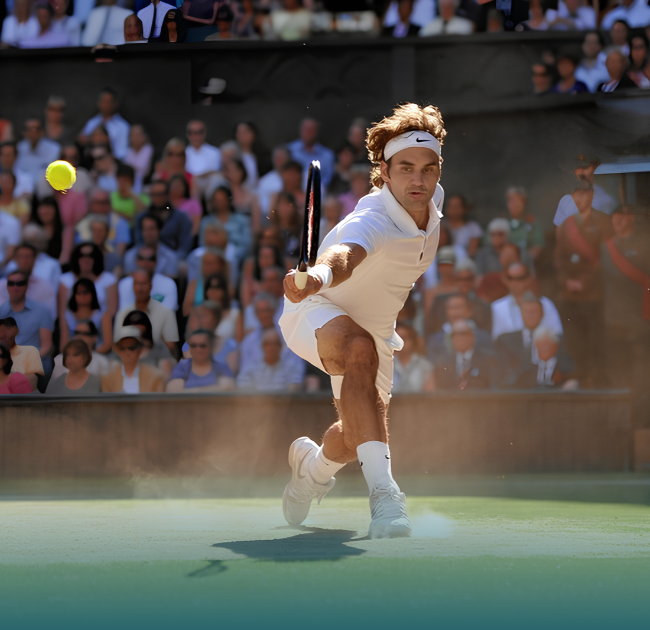
Roger Federer dominated tennis for two decades with a style so fluid that it became synonymous with ease. He won 20 Grand Slam titles, spent 237 consecutive weeks as world No. 1 and played with an elegance that seemed to require no effort. He spent his career correcting that impression. What looked natural, he said, was built in training that no one saw, and the calm he showed on court took years to learn. In December, he plays in São Paulo with our João Fonseca. Here are lessons in how he thinks.
Ease is built. Federer heard that his game seemed to take no effort, and it bothered him. The truth, he said, was that he worked hard to make it look easy, before tournaments, when no one was watching.
It’s only a point. In 1,526 singles matches over his career, he won almost 80% of them but only 54% of the points. The best players in the world lose almost half of what they play for. The difference lies in forgetting the lost point and playing the next one in full.
Tame your own temperament. The teenager who shouted and smashed rackets became the calmest player on tour. Federer says he spent years complaining and throwing rackets before learning to keep his composure. Control, like everything else, was trained.
Reinvent your game when your body asks. At 35, after knee surgery and six months away from the game, Federer rebuilt his backhand, returned and won the 2017 Australian Open. Longevity came from adapting his game to his age, without giving up competing at the top.
Prefer partnership to sponsorship. In 2019, instead of one more advertising contract, Federer became a partner in a then-small sportswear brand, On, and got involved in the product. The decision to think like an owner changed the course of his life after tennis.
Leave the game at peace. Federer ended his career in 2022, at 41, in a farewell alongside his greatest rivals, without staying on longer than he should have. At Dartmouth, he joked that he had not retired from tennis, he had graduated from it.
Did you know?
Before winning his hometown tournament in Basel ten times, Federer worked at it as a ball kid, collecting balls for the professionals he dreamed of becoming. And since 2024 he has officially been a doctor: Dartmouth College awarded him an honorary degree along with the invitation to give the commencement speech, which went viral around the world.
“Talent has a broad definition. Most of the time, it’s not about having a gift. It’s about having grit. Discipline is also a talent, and so is patience. Trusting yourself is a talent. Embracing the process, loving the process is a talent.” Roger Federer, in a speech to the graduating class at Dartmouth, 2024.
Where to go deeper
Luiza Queiroz, head of Strategic Communications at Grupo Turim, recommends three paths for those who want to go deeper into the subject.
Federer: Twelve Final Days, on Prime Video (documentary, 2024). The 12 days between the retirement announcement and the farewell, directed by Asif Kapadia, an Oscar winner. Rare access behind the scenes of a planned exit.
The Master, by Christopher Clarey (book, 2021). The definitive biography, written by the journalist who covered Federer for twenty years at The New York Times. The making of the player, tournament by tournament.
Federer’s Dartmouth speech (speech, 2024). The 25 minutes behind the quote that closes this text, available in full on the university’s official YouTube channel. Worth every minute.